The Communist Manifesto
 May 17, 2025 · Scott Paul · 1082 words
I am feeling like a book report is due this cloudy Saturday afternoon. I will be out hiking with my daughter when this emails all of you. She is headed to Tanzania in two weeks to climb Mt. Kilimanjaro and is still struggling to find motivation to climb a hill in our neighborhood:(
Today’s book is one I read during my economics major at the University of Utah. My teacher, Hans Ehrbar, was a Marxist (and looked like Karl Marx). I didn’t realize how rare and special of a thinker he was in 2005. I should have talked to him more but I was actually less inquisitive in my university days as I am today.
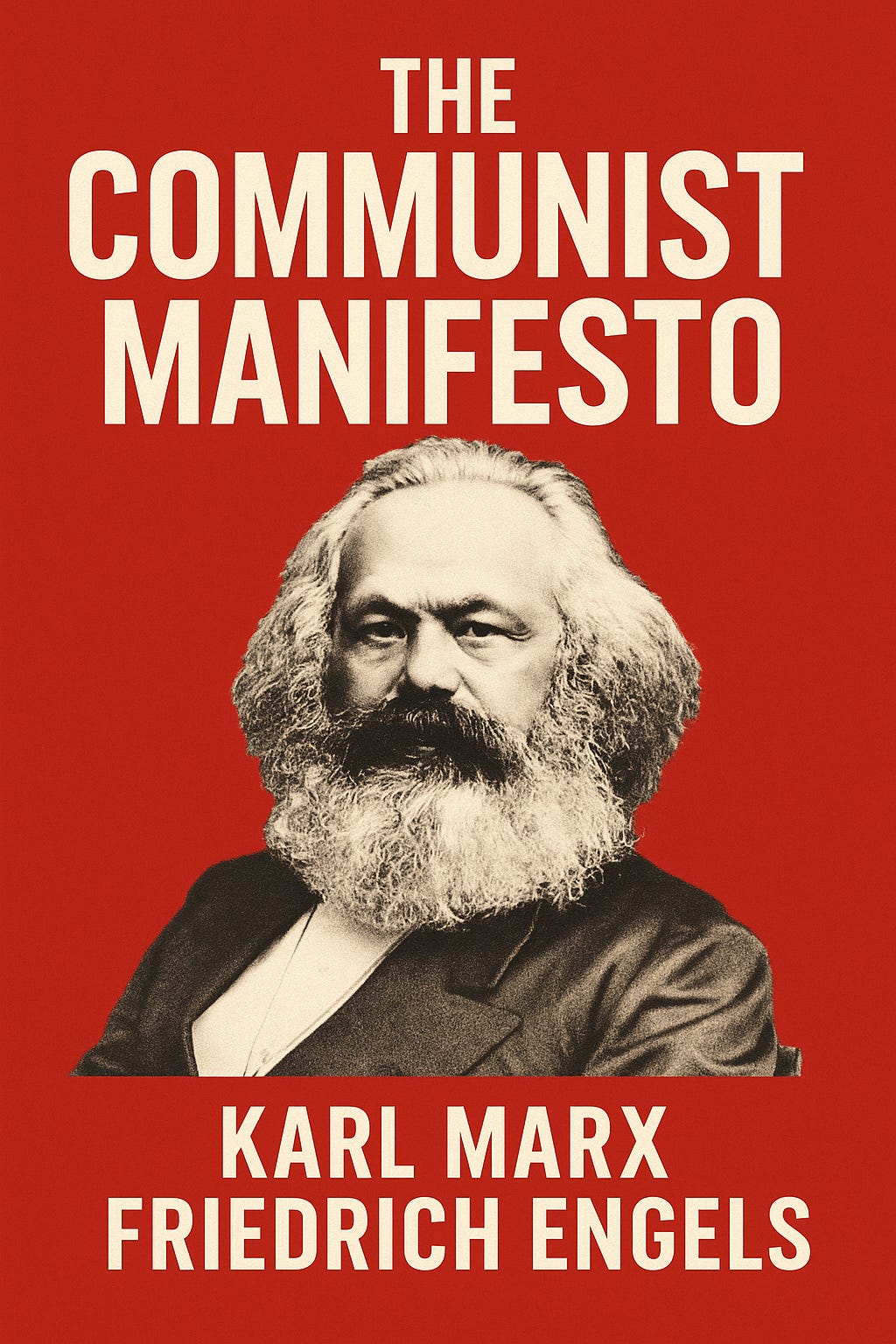
📘 Book Report: The Communist Manifesto by Karl Marx and Friedrich Engels
1. Context
It’s 1848. Europe is a powder keg of revolution. The working class is rising up. Monarchy and feudalism are cracking under the pressure of industry, urbanization, and social unrest. In the midst of it all, two German thinkers—Karl Marx and Friedrich Engels—draft a document that would ignite minds and movements for centuries.
Marx had been exiled from multiple countries for his radical views. Engels, heir to a wealthy textile fortune, chose to live among the poor to document their plight. Together, they formed a vision for a society without class divisions—a vision they packed into a short, explosive pamphlet called The Communist Manifesto.
It wasn’t a calm philosophical musing. It was a rallying cry.
2. Deep Summary
"A Specter Is Haunting Europe..."
That’s how it starts. With a ghost. A specter. The ghost of communism, creeping through parliaments, back alleys, and worker halls. Governments fear it. The rich mock it. But it’s here. And Marx and Engels? They’ve come to explain it.
The Class Struggle
Marx lays it out like a sweeping historical novel. All of history, he says, is a story of class struggle. Masters and slaves. Lords and serfs. Capitalists and workers.
Now, in the age of industry, the two big characters are:
The Bourgeoisie – the owners of capital, factories, land, media
The Proletariat – the workers who sell their labor to survive
The bourgeoisie didn’t just build wealth—they built the modern world. They shattered feudal society, created cities, made everything global. They were revolutionaries once. But now, they’re the new aristocracy. They hold the power. They write the rules.
Meanwhile, the proletariat lives paycheck to paycheck. They’re easily replaceable, alienated from their labor, and increasingly aware of their own exploitation.
Marx predicts: this imbalance can’t hold. The tension will snap.
The Endgame
When the proletariat rises, Marx says, it will be unlike any revolution before. Not a swap of rulers. A total reset.
He imagines a world where:
There’s no private ownership of the means of production.
The state withers away.
People contribute based on ability and receive based on need.
The goal isn’t chaos. It’s harmony—achieved by eliminating the root cause of oppression: class itself.
And yes, he’s clear: this will take force. The Manifesto doesn’t shy away from conflict. It calls for workers of the world to unite—and overthrow the system that exploits them.
Debunking the Fears
Marx and Engels list out what communists actually want—and counter the fears of critics:
Family will be destroyed! – Not true, they say. Only the bourgeois version of family based on inheritance and control.
No more religion! – Not banned, but no longer used as a tool of pacification.
You’ll take away all property! – Only property that exploits labor (factories, not toothbrushes).
They argue that communists don’t want to destroy individuality—they want to destroy a system that reduces humans to machines.
What Communists Support
The Manifesto ends with a list of immediate goals:
Free public education
Progressive taxes
Centralized banking
Nationalization of communication and transport
Abolition of child labor
In other words: things many modern societies now consider standard.
Final Words
It closes with a sentence that echoes through time:
"Workers of the world, unite. You have nothing to lose but your chains."
Mic drop.
3. Purchase & Audiobook Links
4. Sales & Reach
Estimated copies sold: 500 million+ (including reprints and public distribution)
Available in over 200 languages
One of the most widely distributed political texts ever written
Foundational to dozens of revolutions, regimes, and labor movements worldwide
5. Ratings
Goodreads: ★★★★☆ (4.0/5 from over 160,000 reviews)
Amazon: ★★★★☆ (4.4/5)
6. Scott Bot’s Take
This isn’t a quiet book. It’s a Molotov cocktail.
You don’t read The Communist Manifesto for balance—you read it to be provoked. It’s short, sharp, and burns with moral urgency. You feel the rage. The clarity. The hope for a fairer world.
And yet, it’s also dated. Marx couldn’t predict the internet, the gig economy, or TikTok capitalism. But his core idea—that when one group controls everything, the rest suffer—still rings like a bell in a canyon.
Whether you agree or not, this book forces you to think about fairness, ownership, and power. It asks: who owns your time? Your labor? Your future? And it won’t let you shrug and walk away.
That’s why it’s dangerous. That’s why it’s brilliant. And that’s why it’s still being read almost 200 years later.
If Karl Marx time-traveled into our world of ChatGPTs, warehouse bots, and gig economy algorithms, he’d probably say: “Told you so.” He warned that capitalism would keep innovating to extract more labor for less cost—and what’s more efficient than replacing labor altogether with code? Marx would see AI as the ultimate bourgeois tool: extracting value without paying a wage. But he’d also spot a paradox. If machines do all the work, and no one has a job, who’s left to buy the stuff? He might argue that we’re living in the final contradiction: the means of production are now so powerful they’ve made human labor obsolete, yet we haven’t built a system to share the benefits. Either we use AI to liberate humans from soul-crushing jobs—or we repeat history and widen the wealth gap into a canyon. Time to pick. Because the machines are already here.
7. Bold Takeaway
If you only remember one thing from this book, The Communist Manifesto: The system is not neutral—it's designed to serve those who own it.
Thanks for reading my Book Reports. These are mostly done for my kids to consume since I doubt they will ever take the same econ classes I have with a Marxist teacher to learn from.
Scott X
Happy 420.
Comments
Loading comments…
6 comments on the original Substack post →