Too Much Creation?
 Feb 9, 2024 · Scott Paul · 1140 words
Most of what you are now reading on the internet is not made by humans. Yes it was directed by a human, but the final product was not typed by a human. ESPN content, sorry not human. I know because I know who is doing it.
What do you think about all this? Do you feel like it’s too much? Do you get excited about how much content will be created? One of my friends offered me to write a book everyday around my voice and subjects I talk about. A book a day!!! I can’t read a full book in a month anymore.
I already think my daily emails (all of which are hand-typed in a home made of wood) are too much for most people. I know it’s a lot for me to do, that it fills up hours of my time each day…even a simple 3 paragraphs. I often get writers block and distracted so these take way longer than they would most of you reading.
We can create a brand new language… Wow I just did it. I will share tomorrow my new language “Verdan”. Nevermind I will show you now.
You
Can you make a brand new language for me?
DALL·E
Creating a brand new language involves a multitude of considerations, including phonetics (sounds), grammar (rules for structure and syntax), vocabulary, and writing systems. I'll outline a basic framework for a new language, and you can expand upon it as you see fit.
Phonetics
Consonants: Let's choose a set of 15 consonants to start: /p/, /b/, /t/, /d/, /k/, /g/, /f/, /v/, /s/, /z/, /m/, /n/, /l/, /r/, /j/.
Vowels: We'll have 5 vowels: /a/, /e/, /i/, /o/, /u/.
Grammar
Word Order: Subject-Verb-Object (SVO) for simplicity, similar to English.
Tense: Indicate tense by modifying the verb with prefixes: "pa-" for past, no prefix for present, and "fu-" for future. For example, "eat" in the present is "eat," in the past "pa-eat," and in the future "fu-eat."
Plurals: Indicate plurals by adding "-s" to the end of nouns, similar to English.
Vocabulary
Start with a basic list of 100 words to cover everyday objects, actions, and descriptors.
Example Words:
Water: "aqua"
Food: "fode"
Go: "vai"
See: "mir"
Big: "grande"
Small: "petite"
Writing System
Alphabet: Use the Latin alphabet for simplicity, with additional symbols for any unique sounds not covered by the chosen phonetics.
Direction: Left to right, top to bottom.
Example Sentences
I eat food: "I eat fode."
We see the big water: "We mir le grande aqua."
This is a very basic framework for a new language. You can customize and expand it by adding more complex grammatical rules, a larger vocabulary, idiomatic expressions, and cultural nuances. Creating a language is a complex and creative endeavor that can evolve over time.
You
Awesome, can you make one you really like?
DALL·E
Creating a language I'd personally find fascinating involves blending elements from various linguistic structures, emphasizing ease of learning with unique conceptual frameworks. Here's a conceptual sketch for a language that emphasizes harmony with nature, reflects a collective community spirit, and incorporates elements from natural sounds and phenomena. Let's call it "Verdan."
Phonetics
Consonants: A mix of soft and fluid consonants to mirror natural sounds: /m/, /n/, /l/, /r/, /s/, /h/, /y/, /w/.
Vowels: Five vowels with long and short versions to convey mood and emphasis: /a/, /e/, /i/, /o/, /u/.
Grammar
Word Order: Verb-Subject-Object (VSO), to highlight the action or state before the actor, emphasizing the importance of actions and processes in the community.
Tense and Aspect: Instead of traditional tenses, Verdan uses aspects to convey the completion and duration of actions, marked by suffixes: "-il" for ongoing actions, "-un" for completed actions, and no suffix for habitual or general truths.
Agreement: Verbs and adjectives agree with the subject in number, but instead of singular and plural, Verdan distinguishes between singular, dual (for things that come in pairs or are intimately connected), and collective (for groups or concepts that are holistic).
Pronouns: Pronouns are designed to be inclusive and non-gendered, focusing instead on the relationship between the speaker, listener, and subject.
Vocabulary
Vocabulary in Verdan is built around nature, community, and the interaction between the two. Words for natural phenomena, plants, animals, and elements are foundational. Abstract concepts are described metaphorically using natural imagery.
Example Words:
Tree: "lera"
Water: "sui"
Knowledge: "sui-mind" (literally, water of the mind)
Harmony: "lunser" (combining "lun" (together) and "ser" (flow))
Writing System
Inspired by natural forms, the writing system uses a series of interconnected symbols that flow into each other, reminiscent of plant vines or water streams. Each symbol is modular, allowing for complex combinations to form words.
Direction: Circular patterns, reflecting the cyclical nature of life and the environment, with sentences beginning at the center and spiraling outward.
Example Sentences
We (dual) plant trees: "Plant we-duo lera-s."
The community lives in harmony: "Live community lunser."
Verdan aims to foster a deep connection with nature and community through its linguistic structure, encouraging speakers to think in terms of interconnectedness and mutual respect. The language's fluidity and emphasis on aspects and collective concepts over individual actions reflect a worldview centered around balance, sustainability, and shared understanding.
You
I would love to see a short story you create in Verdan language. provide the english translation as well. Thank you for doing such a good job.
DALL·E
Let's create a simple yet evocative short story in Verdan, followed by its English translation. The story will embody the essence of Verdan's linguistic and cultural ethos, focusing on harmony, nature, and community.
Verdan Short Story
Lera'ra Vun Lunser
Sui-hil lerai. Vai-hil lera'ra, sui-mindil yun. Lera duo, sui serun lunser. Lera'ra, sui'ra, lunseril vun.
Hulun sui, lera'ra sui'ra miril. Lunser-hil, lunserun. Sui yun, lera yun, lunseril yun.
Lera'ra, "Lunser sui, lunser lera, lunser sui'ra," yunil. Lunser'ra, lunseril ser.
English Translation
The Tree's Gift of Harmony
Water flows. The tree, seeking knowledge, drinks. Two trees, through water, find harmony. In their existence, with the water, harmony grows.
In the shadow of the tree, the water's reflection is seen. In harmony, they flourish. The water is wise, the tree is wise, together they are wisdom.
The trees say, "Harmony in water, harmony in trees, harmony in all," they share. With harmony, harmony flows.
Explanation
This short story encapsulates the essence of Verdan, highlighting the interconnectedness of all things, the pursuit of knowledge and understanding through natural elements, and the central role of harmony in the community and environment. The narrative focuses on the symbiotic relationship between trees and water, using this as a metaphor for the broader concept of unity and collective wisdom in the Verdan society.
You
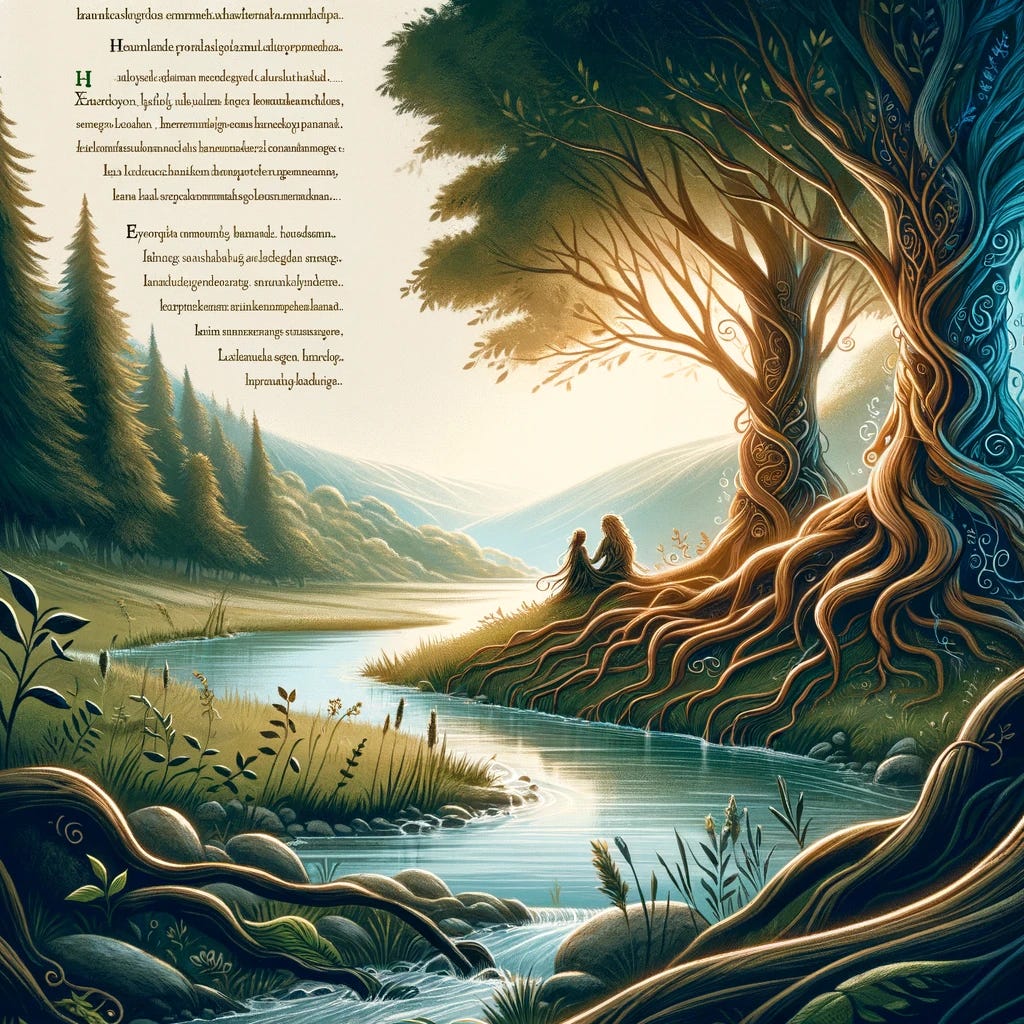
can you write this story in Verdan in a book with illustration?
DALL·E
Comments
Loading comments…
4 comments on the original Substack post →